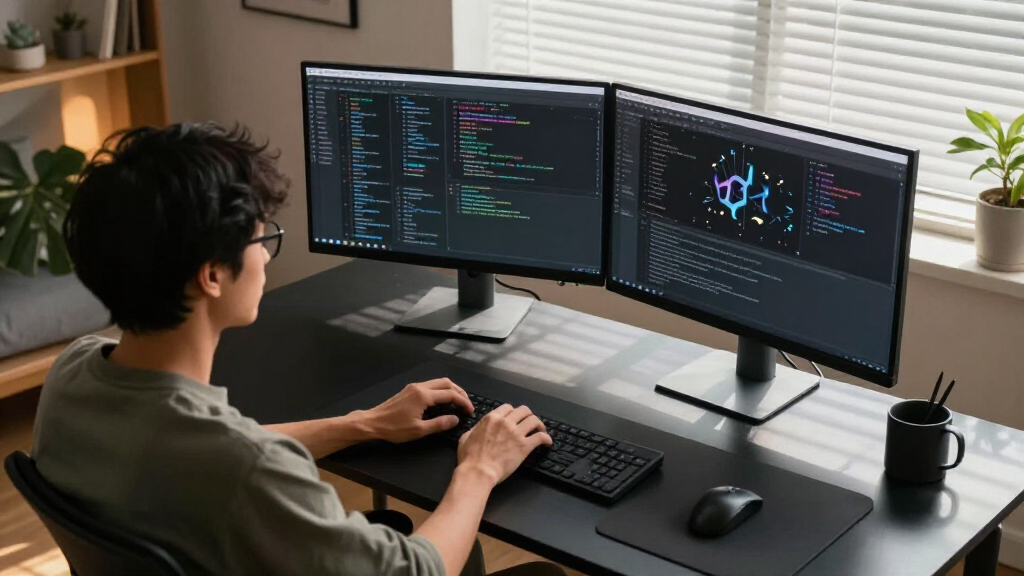

TL;DR

Get movie nights delivered free with Prime
- Fast, free delivery on millions of items
- Prime Video, Amazon Music and more included
- Member-only deals all year
Apple announced a new Mac Studio featuring up to 512GB of unified memory, allowing users to load and run large AI models locally. This development offers a new option for AI research and privacy-sensitive applications outside of cloud reliance.
Apple unveiled a new Mac Studio on 25 August 2026, featuring a configuration with up to 512GB of unified memory. This hardware enables users to load and run frontier-scale AI models locally, a capability previously limited to specialized data center equipment. The announcement highlights a significant shift toward accessible, high-capacity AI workstations for individual researchers and small teams, reducing reliance on cloud infrastructure.
The new Mac Studio is available in two main configurations: the M5 Max with 128GB of unified memory, and the M5 Ultra with up to 512GB of memory. The latter, which starts at $10,800 before storage upgrades, is built by connecting two M5 Max chips via Apple’s UltraFusion interconnect, creating a single, powerful processor with a 1.2 terabytes-per-second bandwidth. This design allows the GPU cores to access the entire memory pool directly, enabling the loading of large models that previously required multiple high-end GPUs in data centers.
Apple claims that the M5 Ultra delivers up to 4.3 times faster AI performance than the previous M3 Ultra and nearly 10 times faster than the M1 Ultra in some benchmarks, though these figures are based on Apple’s own testing and may vary with real-world workloads. The machine’s core advantage is its capacity to hold large models, making it possible for individual users to experiment with models containing hundreds of billions of parameters directly on their desktop.
Implications for Local AI Development and Privacy
This development marks a meaningful step toward democratizing access to frontier-scale AI models, traditionally confined to large data centers. By enabling individuals and small teams to load and experiment with massive models locally, it offers enhanced privacy, control, and flexibility. It also signals a shift in AI hardware toward consumer-grade devices capable of handling complex workloads, potentially reducing dependence on cloud services and associated costs.
However, it’s important to distinguish between capacity and throughput. While the Mac Studio can load and hold large models, its memory bandwidth and compute power limit the speed at which these models can run, especially compared to data center hardware. This means the machine is suited for experimentation, development, and small-scale deployment rather than large-scale production serving multiple users.
Apple Mac Studio with 512GB memory
As an affiliate, we earn on qualifying purchases.
As an affiliate, we earn on qualifying purchases.
Background on AI Hardware and Apple’s Silicon Strategy
Until now, running frontier-scale AI models has required specialized, expensive hardware in data centers, often involving multiple GPUs with large dedicated memory pools. Apple’s move to integrate two M5 Max chips into a unified processor with substantial shared memory represents a significant architectural innovation. This approach leverages Apple’s silicon expertise to bring high-capacity AI hardware into a desktop form factor, aligning with broader trends of democratizing AI development and emphasizing user control.
Historically, Apple’s focus has been on consumer devices and professional workflows, with their silicon primarily optimized for graphics, media, and general computing. The introduction of this high-memory Mac Studio reflects a strategic pivot toward AI workloads, positioning Apple as a player in the emerging market for accessible, high-performance AI hardware outside traditional data centers.
“The M5 Ultra combines innovative architecture and high bandwidth to enable local loading of large AI models, opening new possibilities for privacy and control.”
— Apple spokesperson
high performance AI workstation for home
As an affiliate, we earn on qualifying purchases.
As an affiliate, we earn on qualifying purchases.
Limitations of Speed and Throughput for Large Models
While the Mac Studio can load large models, its actual inference speed and throughput are limited by memory bandwidth and compute power. These factors mean it may not match the performance of dedicated data center hardware, especially for serving multiple users or high-demand applications. The exact real-world performance for various workloads remains to be independently verified, and software ecosystem maturity could affect usability.
professional AI development computer
As an affiliate, we earn on qualifying purchases.
As an affiliate, we earn on qualifying purchases.
Upcoming Benchmarks and Software Ecosystem Developments
Expect independent benchmarks to evaluate the real-world inference speed and efficiency of the new Mac Studio configurations, especially the 512GB model. Software support and optimization for AI workloads on Apple silicon are likely to evolve, potentially improving performance and usability. The market will also observe whether small teams and individual researchers adopt this hardware for serious AI development and deployment, or if limitations in speed and ecosystem maturity restrict its use to experimentation.
large memory desktop computer for AI
As an affiliate, we earn on qualifying purchases.
As an affiliate, we earn on qualifying purchases.
Key Questions
Can the new Mac Studio replace data center GPUs for AI training?
No, the Mac Studio is designed primarily for inference and experimentation. Its bandwidth and compute limitations mean it cannot match the speed and scale of dedicated data center GPUs used for large-scale training or serving many users simultaneously.
What types of AI models can run on the Mac Studio with 512GB memory?
It can load and run very large models, including frontier-scale models with hundreds of billions of parameters, suitable for research, development, and privacy-sensitive inference tasks.
Is the software ecosystem mature enough for production AI workloads on Apple silicon?
While progress has been made, Apple’s local machine learning tools are still developing compared to established GPU platforms. Some workflows may require porting or may perform better on other hardware.
When will the 512GB memory model be available to purchase?
The 512GB configuration is expected to arrive in late October 2026, following the initial release on September 22, 2026, with preorders already open.
How does this development affect AI privacy and control?
Running large models locally means users can keep their data and models entirely on their hardware, reducing dependence on cloud providers and enhancing privacy and control over sensitive information.
Source: ThorstenMeyerAI.com
Fall Picks
fall essentials
As an affiliate, we earn on qualifying purchases.