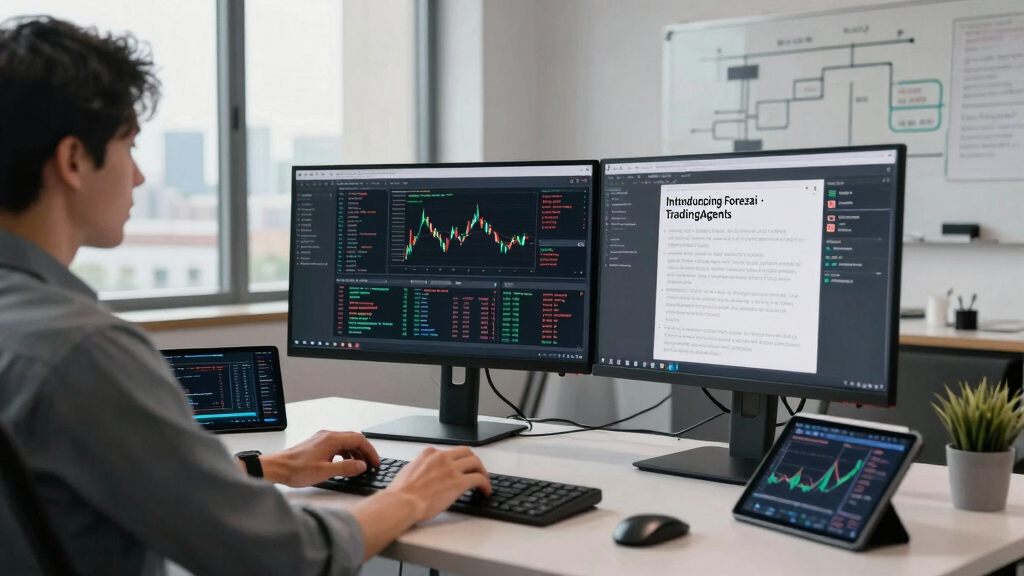

📊 Full opportunity report: Introducing Forezai · TradingAgents — a committee of LLMs decides paper-trades on ThorstenMeyerAI.com — validation score, market gap, and execution plan.

Get movie-night favorites delivered free — and shop member deals
- Fast, free delivery on millions of items
- Access to Prime Big Deal Days deals on October 6–7
- Prime Video, Amazon Music and more included
TL;DR
Forezai · TradingAgents is a new fork of a multi-LLM trading framework that automates paper-trading using a committee of specialized language models. It adds operational tools like scheduling, order management, and a web dashboard, enabling research without risking real money.
Forezai · TradingAgents, a new fork of an existing multi-agent LLM trading framework, now includes operational features that enable autonomous paper-trading, marking a significant step in AI-driven financial research.
The project extends the original TradingAgents framework, which uses a committee of thirteen specialized large language models (LLMs) to analyze market data, debate, and produce trading recommendations. Unlike prior versions, the Forezai fork incorporates an autonomous scheduler, order management, position evaluation, and a web dashboard, allowing researchers to run continuous experiments without manually intervening or risking real capital.
This system maintains the core architecture: multiple analyst roles, debate stages, risk assessment, and decision synthesis, but now adds operational layers such as a multi-broker abstraction supporting local, paper, and shadow modes, as well as a web interface built with FastAPI and React. The platform runs locally, with no data sent to the cloud, and uses ChatGPT Pro via Codex OAuth for LLM operations, ensuring secure and controlled experimentation.
Introducing Forezai · TradingAgents.
A committee of LLMs
decides paper-trades.
Analysts · Debate · Risk · Decision
combined with -33% bankroll
services, HTTP routes (starting baseline)
(falls back to public API per token)
The bet is on a different mechanism, not a different parameter setting. The point is not to find a money-printing AI. The point is to put honest measurements of these systems into the public record — so the next person looking at the space starts a step further along than the last.Thorsten Meyer AI · Introducing Forezai · TradingAgents · § 03
Potential Impact on AI-Driven Trading Research
The addition of operational tools to a multi-LLM decision-making framework enables systematic, repeatable research into AI-based trading strategies. It allows researchers to evaluate the effectiveness of LLM committees in making trading decisions in a simulated environment, providing insights into their potential and limitations without financial risk. This development could influence future AI trading systems, risk management approaches, and the broader understanding of AI reasoning in complex decision-making contexts.
As an affiliate, we earn on qualifying purchases.
Background of Multi-LLM Trading Frameworks
The original TradingAgents framework, developed by TauricResearch, was designed to test whether a committee of specialized LLMs could produce trading decisions comparable to human managers, without claiming predictive accuracy. Prior experiments involved paper-trading against Polymarket prediction markets, revealing that many parametric strategies fail in live conditions despite promising backtests. The framework emphasizes explicit reasoning and debate among models, not raw prediction accuracy.
The recent launch of Forezai · TradingAgents builds on this foundation, shifting from a research prototype to a more operational tool capable of running continuous experiments, which is crucial for assessing the practical viability of AI-driven trading committees.
“By adding operational features, Forezai · TradingAgents transforms a research prototype into a practical platform for ongoing AI trading experiments, without risking real capital.”
— Thorsten Meyer, project lead
As an affiliate, we earn on qualifying purchases.
Unanswered Questions About Model Performance and Risks
It remains unclear how well the committee of LLMs will perform in live trading conditions over extended periods, especially regarding robustness, adaptability, and susceptibility to market anomalies. Since the system currently operates in paper mode, its real-world effectiveness and potential for profitable deployment are still untested.
Additionally, questions remain about how the models’ reasoning can be interpreted, how biases might influence decisions, and whether the framework can scale to more complex or volatile markets.
As an affiliate, we earn on qualifying purchases.
Next Steps for Testing and Validation of the System
The project team plans to run extended simulations and live paper-trading sessions to evaluate the committee’s decision quality and stability. They will also refine the operational tools, improve logging and transparency, and potentially prepare for controlled live trading with real capital, explicitly noting that current use remains experimental.
Further research will focus on analyzing the reasoning debates among models, assessing risk management effectiveness, and exploring scalability to different asset classes or market conditions.
As an affiliate, we earn on qualifying purchases.
Key Questions
Can this system be used for real trading now?
No, the current version operates solely in paper mode and is intended for research and testing purposes. It explicitly does not risk real money.
How does the committee of LLMs make decisions?
The system employs specialized roles—analysts, debate agents, risk teams, and a portfolio manager—that argue, synthesize, and articulate reasoning based on market data, rather than directly predicting market movements.
What are the main advantages of this approach?
By structuring reasoning through debate and explicit articulation, the framework aims to produce more transparent and potentially more robust trading decisions compared to single-model predictions or rule-based strategies.
Will the system be able to adapt to different markets?
Adaptability is still under investigation. Future testing will explore performance across various asset classes and market conditions to assess scalability and resilience.
What are the main limitations right now?
The system’s effectiveness in live trading remains unproven, and it currently lacks mechanisms for real-time risk management or handling extreme market events. Further validation is required before considering deployment beyond research.
Source: ThorstenMeyerAI.com
Halloween Picks
halloween
As an affiliate, we earn on qualifying purchases.