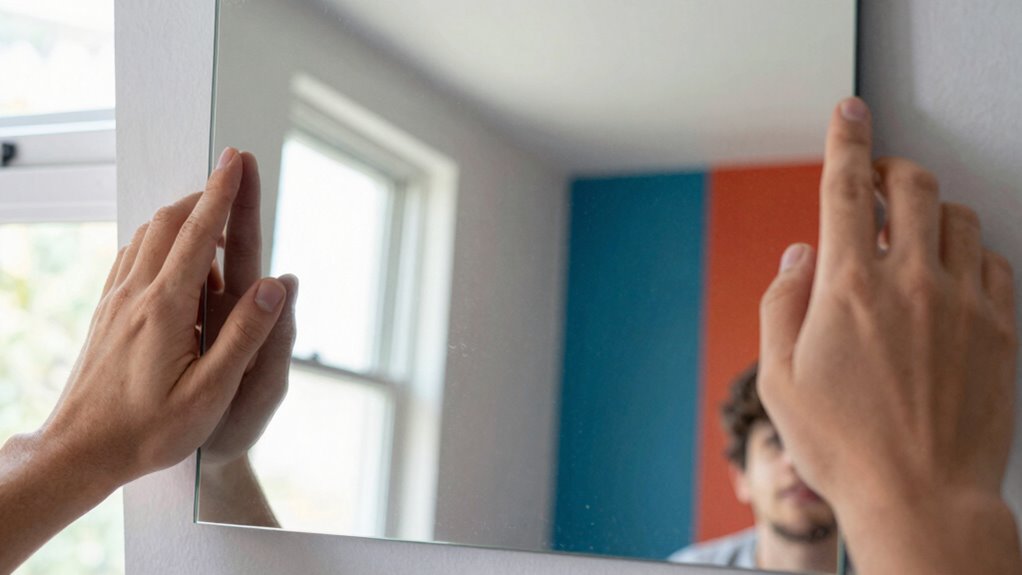

Mirrors don’t actually reverse left and right; they reverse front and back along the axis perpendicular to their surface. Because of how your brain interprets images, it seems like left and right are swapped, but it’s really a visual flip. Up and down aren’t reversed because gravity keeps your orientation consistent. This perception is influenced by your habits and how your mind processes images. If you want to understand why this happens, keep exploring how reflection and perception work.
Key Takeaways
- Mirrors reverse front and back along the axis perpendicular to their surface, not left-right or up-down directly.
- The perceived left-right reversal is a cognitive interpretation, not a physical change in the object.
- Up and down are not reversed because gravity maintains vertical orientation, influencing perception.
- Our brains expect horizontal flips for faces and objects, creating the illusion of left-right reversal.
- The reversal is a visual and perceptual illusion, stemming from how we interpret reflections, not a physical mirror property.
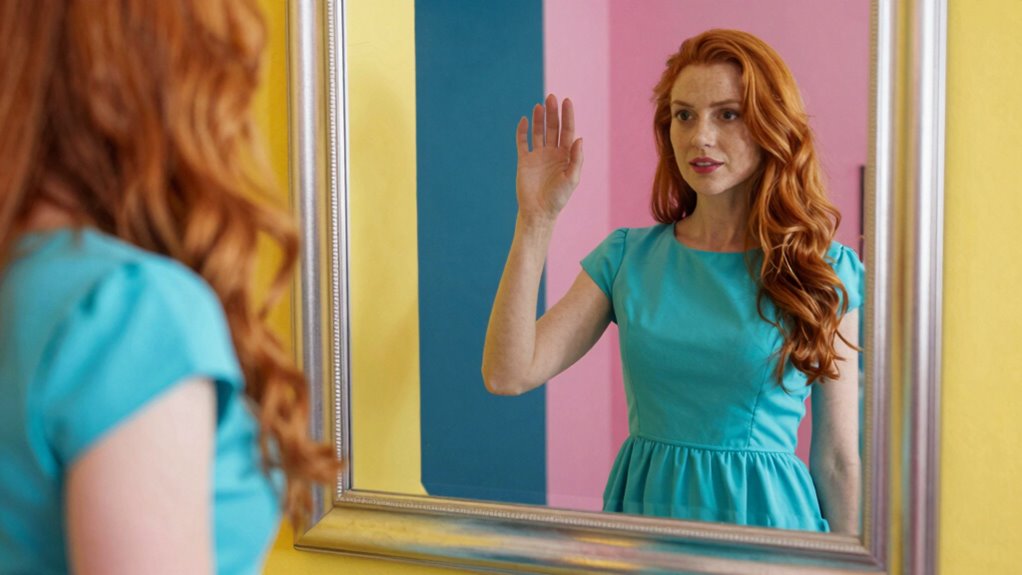
When you look into a mirror, it might seem like it’s reversing your left and right sides, but in reality, mirrors don’t actually switch directions. Instead, what you’re experiencing are optical illusions rooted in perception differences. Our brains interpret the reflected image in a way that makes it feel like your left and right are swapped, but this isn’t actually happening physically. It’s a trick of perspective. A mirror simply reverses front and back, flipping the image along the axis perpendicular to its surface. So, your reflection isn’t truly flipping left to right; it’s mirroring what’s directly in front of it.
Mirrors reverse front and back, creating an illusion of left-right swap through perception, not actual physical reversal.
This phenomenon is tied to how we perceive ourselves and interpret images. When you turn your head to the right, your reflection appears to turn to the left, creating the impression of left-right reversal. But in truth, the mirror isn’t doing anything special with your sides—it’s just reversing the dimension that goes into the mirror. Our perception differences make us interpret this reversed image as a left-right switch, even though the mirror is only reversing the front-back axis. This is why mirrors don’t reverse up and down—gravity keeps your head and feet in the same position relative to the mirror, so there’s no reason for a perceived flip along that axis. Additionally, visual perception plays a crucial role in how we interpret these reflections and illusions.
Optical illusions play a significant role in how we see these reversals. Our brains are wired to interpret images based on familiar experiences and assumptions. When we see our reflection, we assume that the mirror should flip the image along the horizontal plane, but it actually flips it along the axis facing us. This causes the perception differences that lead us to believe our left and right are swapped. It’s not a physical reversal but a visual and cognitive interpretation. Recognizing the reflection axes involved can help clarify how this illusion works and why it’s tied to our perception rather than physical reality. Additionally, understanding the perception of spatial orientation can deepen our insight into how these illusions influence our understanding of reflection.
Ultimately, the reason mirrors seem to reverse left and right, but not up and down, hinges on how we process the visual information. Your brain’s expectation of how a face or object should appear influences your perception. Because turning your head or moving left and right changes your position relative to the mirror, your brain interprets the image accordingly, reinforcing the illusion of reversal. So, it’s not the mirror that’s doing the reversing—it’s your perception, shaped by optical illusions and habitual ways of viewing the world. Moreover, awareness of spatial perception and reflection axes can help us comprehend the underlying causes of these illusions and better understand how our brains interpret visual information.
full length mirror with clear reflection
As an affiliate, we earn on qualifying purchases.
As an affiliate, we earn on qualifying purchases.
Frequently Asked Questions
Do Mirrors Actually Reverse Images or Just Reflect Them?
Mirrors don’t actually reverse images; they reflect them. When you look into a mirror, optical illusions and cognitive perception influence how you interpret the reflection. Your brain expects a reversed image, so it appears flipped left to right. However, vertically, your brain perceives the reflection as natural because up and down aren’t typically reversed in reflections. This interplay between optical illusions and perception explains why mirrors seem to reverse only certain directions.
Why Does My Reflection Appear Flipped but Not Objects Behind the Mirror?
Your reflection appears flipped because of mirror illusions and reflection physics. When you face the mirror, your left and right seem reversed, but up and down stay the same. The mirror reverses the front-back axis, which our brains interpret as left-right. This is due to how our brains process spatial orientation, not because the mirror actually flips anything vertically. The physics of reflection creates this visual trick, making your reflection seem reversed only in a horizontal sense.
Can Mirrors Reverse Front and Back Instead of Left and Right?
Mirrors don’t reverse front and back; instead, they invert your spatial perception along the axis perpendicular to their surface. This is due to mirror orientation, which causes your reflection to appear flipped in depth, not left or right. When you raise your right hand, the mirror’s reflection shows the same; it’s your perception that interprets the image as reversed. So, the mirror’s effect fundamentally relates to how we perceive spatial orientation, not actual reversal of front and back.
How Does the Human Brain Interpret Mirror Images Differently?
Your brain perception of mirror images is like decoding a secret message, reshaping your spatial orientation instantly. It interprets left and right reversals more naturally because it’s used to recognizing faces and objects from different angles, which can flip your view. Up and down remain consistent because gravity anchors your spatial awareness. Your brain’s incredible adaptability enables you to see mirror images as familiar, even when they challenge your sense of orientation.
Are There Types of Mirrors That Don’t Reverse Left and Right?
Yes, some mirrors don’t reverse left and right, like concave or convex mirrors used in optical illusions and certain optical devices. These mirror distortions alter how images appear, preventing typical left-right reversal. When you look into a standard mirror, it’s the reflection’s orientation that tricks your brain, but with specialized mirrors, the image can stay upright or be manipulated differently. So, it’s all about the mirror’s shape and purpose.
As an affiliate, we earn on qualifying purchases.
Conclusion
So, next time you look in a mirror, remember it’s not actually flipping your image left or right, but rather reversing front and back—like a book opening in reverse. Your reflection appears reversed because your brain interprets the mirror’s image as if it’s turned around, but up and down stay the same. It’s a fascinating illusion, like a dance you’re both part of and watching, that makes mirrors feel both familiar and strangely perplexing.
As an affiliate, we earn on qualifying purchases.
As an affiliate, we earn on qualifying purchases.